


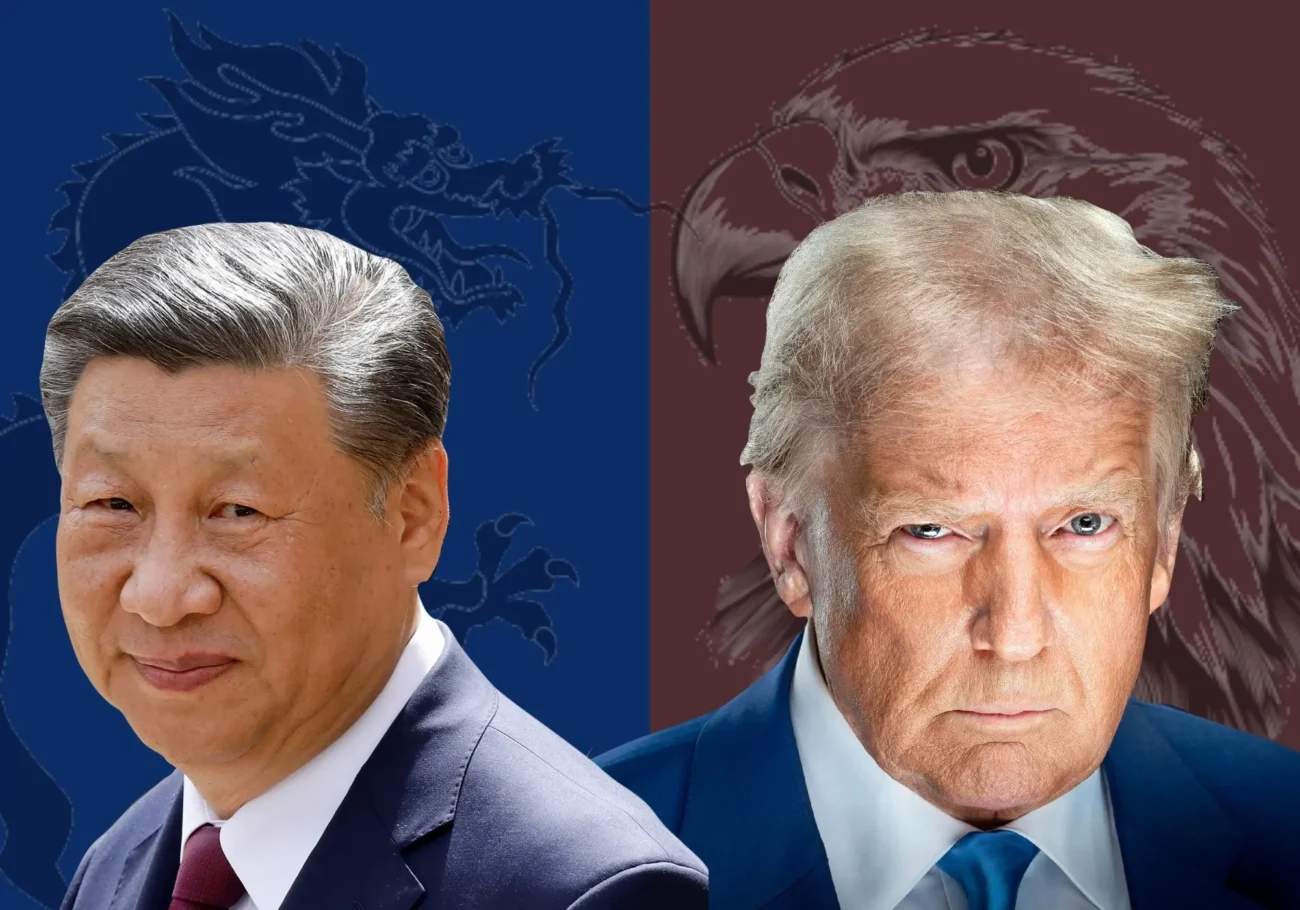
Much was made of the pageantry surrounding President Trump’s China visit – the Zhongnanhai Garden tour, the Strait of Hormuz diplomacy, the Boeing aircraft deal. However, none of it was the real story. The real story was a single question Xi put to Trump across the table: Can China and the United States transcend the so-called Thucydides Trap and forge a new paradigm of relations between major countries?
The Buildup
The US trade deficit in goods was the world’s largest at over $1 trillion in 2025, and the Trump school of thought explained that with such a huge difference in imports over exports, US manufacturers are suffering a huge loss, while foreign manufacturers enjoy benefits that shouldn’t accrue to them.
Countries With The
Biggest Trade Deficits
Each country’s total goods trade deficit — how much more they import than they export with the entire world.
Trump cited on social media: “The USA has major deficits with Canada, Mexico, and China — and we’re not going to be the ‘Stupid Country’ any longer. MAKE YOUR PRODUCT IN THE USA AND THERE ARE NO TARIFFS.”
What followed was a stacked deck.
Trump’s tariffs on China: Full timeline
On the surface, Trump wanted US manufacturers to enjoy more patronage both in the US and beyond. However, beneath this facade lay a bitter truth: China was creeping too close to the US, and the US was unwittingly falling into the Thucydides Trap.
The tariff plan failed woefully, in between China’s rare earth wildcard and the Supreme Court’s tariff reversals, but Trump, true to form, was not going to back down easily.
Whatever the calculation behind it, Trump announced a visit to China, slated for around April. It was awkward, but it raised an uncomfortable question:
How, then, would the US maintain leverage over Beijing, and what was Trump’s plan to make China aware of it?
Oil and the Barons
China is the world’s largest importer of crude oil. It consumes roughly 16 million barrels every single day, more than any other nation on earth. And it has spent decades quietly stitching together a web of suppliers designed to keep that flow uninterrupted.
Russia, Saudi Arabia, Iraq, and a constellation of sanctioned states (Iran and Venezuela chief among them) fed China’s refineries at steep discounts, free from Western banking rails, invisible in official customs data.
According to energy analytics firm Kpler, Venezuela and Iran combined for 17% of Chinese oil imports in 2025.
On January 3 and February 28, US forces targeted both countries and controlled a large stake in the global oil flow. There are different schools of thought over the endgame, but I strongly believe Trump and the US strategists had the China meeting near the top of their reasons.
The China Trip
On the surface, we saw two leaders, warm handshakes, a grand setting, and global cameras. However, what unfolded underneath was a very unequal exchange.
What Trump walked in wanting
- 500 Boeing jets (he floated this publicly before the trip)
- Chinese pressure on Iran
- Rare earth export guarantees
- Fentanyl enforcement commitments
- Broad trade deals to sell politically at home
- Some kind of concession on Taiwan
What Trump walked out with
The only specific deal Trump announced was a commitment by China to purchase 200 planes from Boeing (not the 500 he had floated). For perspective, that Boeing transaction is not dramatically larger than the agreement announced the previous week for Malaysia’s AirAsia to buy 150 Canadian-made Airbus jets.
On Iran, Beijing agreed to keep the Strait of Hormuz open and stated that Iran should not obtain nuclear weapons. The harder test is whether Beijing pressures Tehran, curbs Chinese purchases of Iranian oil, or turns general language into observable outcomes.
Lastly, we had an agreement over a “Board of Trade” and “Board of Investment” and to expand two-way trade under what Beijing called a “reciprocal tariff reduction framework.” However, no numbers and binding commitments make analyzing this extremely difficult.
What Xi walked in wanting
- “Strategic stability” (a framework framing the relationship as manageable, not adversarial)
- Taiwan off the table as a concession item
- No new technology export controls
- American business re-engagement with China
- Time
What Xi walked out with
The term “strategic stability,” which Xi introduced and Trump accepted as the guiding framework, was described by the director of the China program at the Stimson Center as “the most important achievement from the summit for Beijing.” It signifies a shift toward a more positive trajectory. Beijing will treat this as the guiding framework for the next three years and beyond.
On Taiwan, Xi warned Trump that the US and China “will have clashes and even conflicts” if Taiwan’s independence is mishandled, calling it “the most important issue in US-China relations.” Secretary Rubio tried to downplay it afterward — but Xi had put it on the record, in the room, on day one.
The presence of $16 trillion worth of US CEOs in Trump’s delegation provoked real doubts about whether decoupling the US economy from China was still the plan. Those CEOs were there because they wanted access. Beijing gave them the optics of welcome without making structural concessions.
Can they escape the trap?
Xi’s question in the opening session was a deliberate move. He was not asking Trump whether war was coming. He was telling him something about the nature of the game they were both already playing, and whether the man across the table understood the rules.
The Thucydides Trap is, at its core, about psychology; the specific dread that grips an incumbent power the moment it realises the rising power is an inevitability.
Consider what the United States did in the twelve months leading up to the China visit. It launched the most aggressive tariff campaign in modern history, threatened chip export controls, captured Maduro in a predawn raid in Caracas, and bombed Iran two months later.
The Busan truce expires in November, and while I think both sides will want to extend a little further to get more balance and stability, the elephants in the room – rare earths, semiconductors, Taiwan, AI, the shape of the next global order – remain entirely unresolved.
Do I think China and the US can overcome the Thucydides Trap? Ultimately, No. The Thucydides Trap concept itself predicts that structural rivalry eventually overwhelms diplomatic management. But for now, I believe peace and the false sense of alignment benefit both parties. The US keeps its world power status, and China, its industrial hub status.